How Rapport Actually Works (And Why Most Cops Get It Wrong)
By Sgt. Jon Rappa
Let me start with a question:
If you asked ten cops what “rapport” means… how many different answers do you think you’d get?
Nine different definitions and one officer who shrugs and says,
“Uh… be nice?”
Yeah. Exactly. And that right there is why so many interviews fall apart before they even begin. Most cops treat rapport like a polite warmup. A couple lines of small talk. A quick “where you from?” before they jump into the real questions.
But real rapport, the kind that gets people to talk, trust you, and tell you things they’ve never told anyone-isn’t small talk.
It’s science. It’s skill. It’s the entire interview. Let’s break it down.
Lorem ipsum dolor sit amet, consectetur adipiscing elit. Ut elit tellus, luctus nec ullamcorper mattis, pulvinar dapibus leo.
1. Rapport Isn’t “Being Nice.” It’s Creating a Connection.
In my book, Extracting the Truth, I talk about the big four:
- Rapport
- Connection
- Trust
- Empathy
People think these are buzzwords. They’re not; I HATE buzzwords! They’re the four legs holding up the entire chair you’re about to sit in. And here’s the part nobody tells you:
Rapport isn’t the beginning of the interview. Rapport is the ENTIRE interview.
It’s what decides:
- whether a victim actually opens up
- whether a witness remembers more
- whether a suspect talks… or shuts down and asks for a lawyer
Real rapport happens when the person feels three things:
- You get them
- You’re not judging them
- You listen more than you talk
Those three ingredients beat every interrogation theme, tactic, and trick ever invented.
2. People Like People Like Themselves (Yes… It’s Real Science)
Here’s a psychological truth: People trust people who feel similar to them. It’s called the similarity-attraction effect.(Byrne, 1971; Montoya et al., 2008). And it’s the reason your small talk matters. Not because you’re trying to be friendly, but because you’re hunting for common ground:
- Kids
- Family
- Work
- Struggles
- Music
- Hobbies
- Neighborhoods
- Anything that quietly says, “We’re not that different.”
But here’s where cops blow it: They walk in with judgment written across their face like a billboard. Suspects feel it instantly. Victims feel it. Witnesses definitely feel it.
You have to shut your judgment off.
Not because they deserve sympathy-
but because empathy is a tactical advantage.
3. Remove the Barriers. All of Them.
Interview rooms are full of built-in obstacles. A giant table. A chair pushed ten feet back. You sitting like you’re about to conduct a job interview.
Fix it.
- Move the chair
- Angle your body
- Relax your face
- Use first names
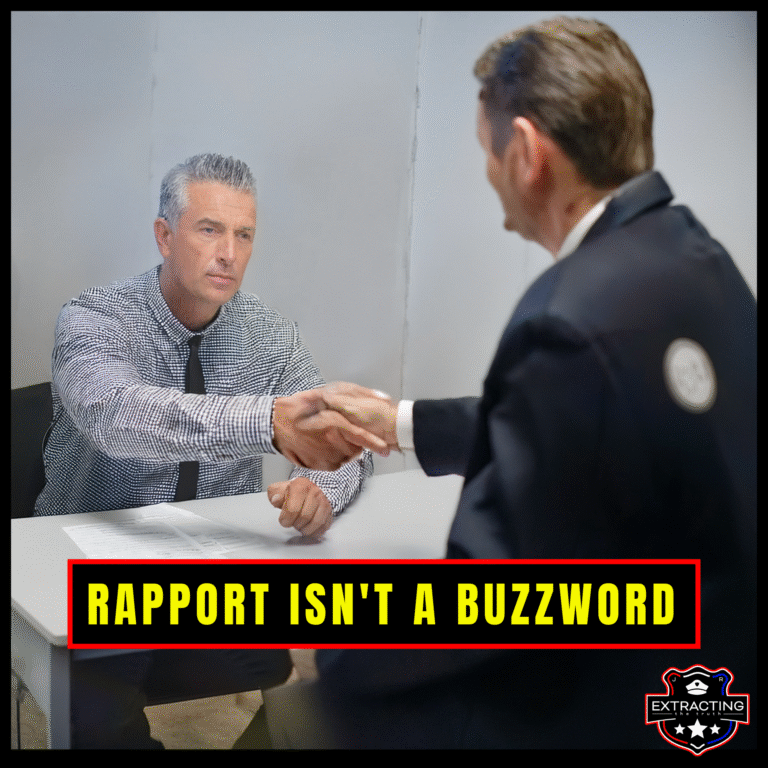
- Shake hands when appropriate
- Sit with them, not across from them
Watch Oprah Winfrey. She has this down to a science! Your body language broadcasts whether you’re safe… or whether you’re a threat. And when you’re wearing a uniform and badge? Trust me, you don’t need extra help looking like authority.
4. The Biggest Mistake: Turning Into a Robot
You’ve seen this transformation: A perfectly normal human being walks into the interview room…and suddenly switches into Interview Mode.
Posture locked.
Emotions off.
Voice flat.
Smiles restricted by department policy.
Stop doing that. The best interviewers in the world, from homicide detectives to intelligence interrogators, all have one thing in common: They stay human.
5. Listening Is Your Superpower (And Most Cops Don’t Use It)
This is something I preach in my book and every class I teach:
Shut up and listen.
Most cops interrupt nonstop and don’t even realize it. But the research is crystal clear:
- The longer a witness talks uninterrupted, the more details they recall
- Suspects spill more information in silence than during active questioning
- Pauses make people uncomfortable—and they fill the space with truth
Listening builds rapport faster than any line you could ever say.
Let them talk.
Let them feel heard.
Let them tell their version; even if it’s garbage at first.
You’re not agreeing.
You’re understanding.
And understanding leads to cooperation.
6. Judgment Kills Interviews
Here’s a universal rule: The second a suspect feels judged, the interview is over.
Same with victims.
Same with witnesses.
This is why empathy works even with the worst of the worst; murderers, pedophiles, violent offenders. You’re not excusing anything. You’re not saying what they did is okay. You’re simply showing: “I’m here to understand, not condemn.”
That’s when walls fall.
That’s when communication starts.
That’s when the truth comes out.
7. Rapport Isn’t a Step. It’s the Whole Strategy.
This is the biggest mindset shift I try to drill into officers everywhere: Rapport is not Step 1. Rapport is Step 1 through Step 100.
It never stops.
It never ends.
It gets reinforced constantly; in how you sit, how you speak, how you listen, and how you respond.
When you build real rapport:
- People tell you more
- People correct themselves
- People trust you
- People drop their guard
- People become emotionally invested
- People confess
- People cooperate
Rapport is the backbone of ethical, modern investigative interviewing…everywhere in the world.
Final Thought
Want to become a great interviewer? Stop obsessing over tricks, tactics, and “gotcha” lines. Start obsessing over this question:
“Do they feel safe talking to me?”
If the answer is yes, the interview opens up.
If the answer is no, the interview collapses.
Rapport makes, or breaks, the entire thing.
🎓 Extracting the Truth: Interview & Interrogation Training delivers real cases, real videos, and real results-trusted by patrol officers, investigators, and FTOs nationwide. 👉 https://extractingthetruth.com