
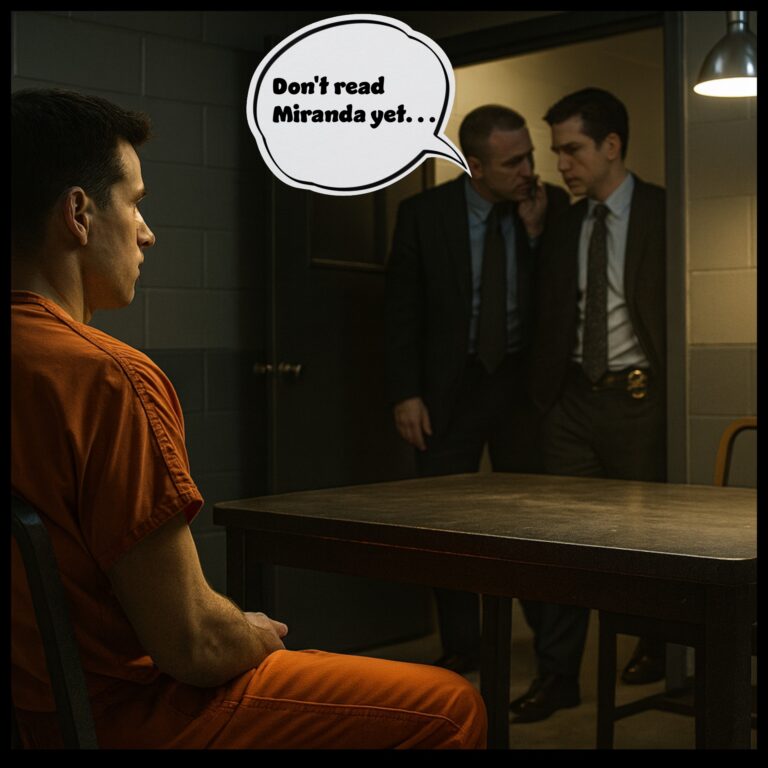
Case Spotlight: Missouri v. Seibert (2004)
By Sgt. Jon Rappa
What happens when officers get a confession before Miranda… and then try to “fix it” afterward?
In Missouri v. Seibert, the Supreme Court shut down a tactic some officers once used: get a confession before Miranda, take a short break, then read Miranda rights and get the suspect to repeat the same confession on tape.
The problem?
It wasn’t an accident. It was intentional; a strategy designed to make Miranda meaningless.
Lorem ipsum dolor sit amet, consectetur adipiscing elit. Ut elit tellus, luctus nec ullamcorper mattis, pulvinar dapibus leo.
The Court ruled that any confession obtained after a midstream Miranda warning is inadmissible when officers intentionally use a two-step technique to sidestep the rules.
The key takeaway
If a suspect has already confessed during an unwarned interview, a quick Miranda warning doesn’t magically fix it. The warning becomes hollow because the suspect already feels committed to what they’ve said.
The controlling opinion (Justice Kennedy)
Kennedy clarified the rule we follow today:
If the two-step tactic was deliberate, the post-warning confession must be thrown out unless officers take strong corrective steps; like a long break or a second warning that makes clear the first confession is inadmissible.
The keyword here is deliberate. Sometimes, during non-custodial interviews, suspects do make admissions or confessions.
Why this matters for us
This case is a reminder that Miranda is a safeguard that only works if we apply it before custodial questioning begins. Once someone confesses without Miranda, the ground is already tainted.
For patrol, detectives, and anyone conducting interviews:
Avoid midstream Miranda. If it’s custodial and you’re about to ask guilt-seeking questions, stop and Mirandize first.
🎓 Extracting the Truth: Interview & Interrogation Training delivers real cases, real videos, and real results-trusted by patrol officers, investigators, and FTOs nationwide. 👉 https://extractingthetruth.com